How 4G and 5G Wireless Routers Are Transforming Security Surveillance
Introduction
Security surveillance systems have become an essential part of modern life. From residential security and retail stores to construction sites, warehouses, farms, and industrial facilities, IP cameras are widely used to monitor properties, protect assets, and improve safety.
However, one challenge remains common across many surveillance projects: How can security cameras stay connected when traditional wired broadband is unavailable, unreliable, or too expensive to install?
This is where 4G and 5G wireless routers come in.
By using cellular networks to provide internet connectivity, 4G LTE and 5G CPE routers offer a flexible and reliable networking solution for security surveillance systems. They make it possible to deploy IP cameras in locations where fixed broadband infrastructure is limited or unavailable.
In this article, we explore how 4G and 5G wireless routers are used in security surveillance and why they are becoming an increasingly attractive option for security system integrators, installers, and equipment distributors.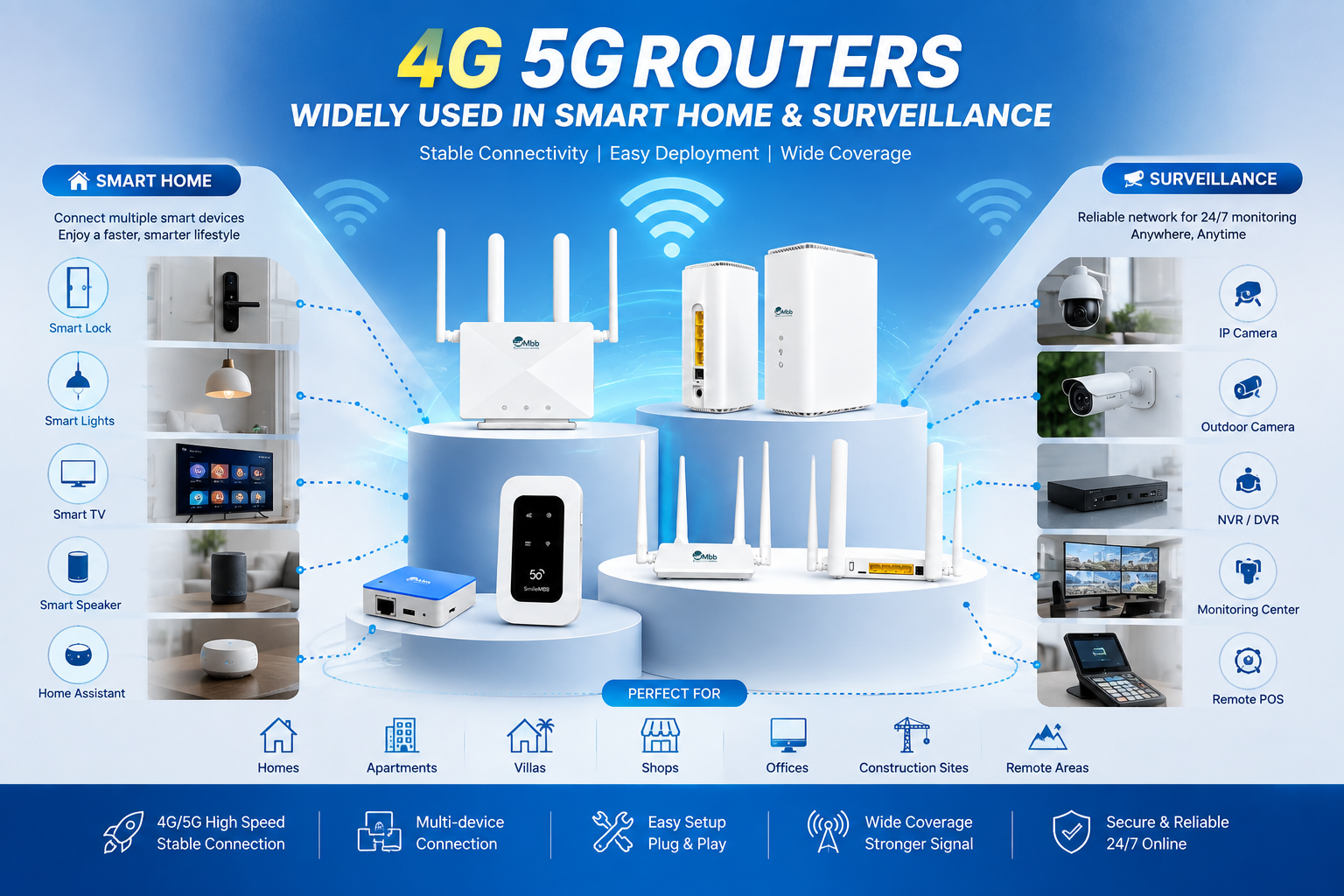
1. Why Does Security Surveillance Need Wireless Connectivity?
Traditional IP surveillance systems typically rely on fixed broadband connections, such as fiber or Ethernet, to transmit video footage to remote monitoring platforms.
While this approach works well in locations with established network infrastructure, it can create several challenges:
-
No fixed broadband access: Remote farms, rural properties, construction sites, and temporary facilities may not have fiber or wired internet access.
-
High installation costs: Extending network cables or fiber connections to multiple camera locations can be expensive and time-consuming.
-
Limited deployment flexibility: Cameras installed in temporary or frequently changing locations need a more flexible internet connection.
-
Network interruptions: A failure in the primary broadband connection can interrupt remote video monitoring.
For these situations, cellular connectivity provides an alternative. A 4G or 5G wireless router can connect to a mobile network through a SIM card and provide internet access to surveillance devices.
2. Key Applications of 4G/5G Routers in Security Surveillance
A. Remote and Rural Surveillance
Many surveillance locations are far away from urban infrastructure, including farms, agricultural fields, rural warehouses, and isolated properties.
Installing fiber broadband in these areas may be impractical or uneconomical.
A 4G LTE CPE router solves this problem by connecting to the local cellular network and providing internet access to IP cameras.
Typical applications:
-
Farm and agricultural monitoring
-
Rural property security
-
Remote warehouses and storage facilities
-
Livestock and greenhouse monitoring
-
Perimeter security
With a SIM card and suitable cellular coverage, surveillance cameras can transmit video to remote monitoring platforms without requiring a fixed broadband connection.
B. Construction Sites and Temporary Surveillance
Construction sites often require security monitoring throughout different stages of a project. However, these locations may not have permanent internet infrastructure.
Installing a wired broadband connection for a temporary project can increase both deployment time and costs.
A portable 4G/5G wireless router offers a more convenient solution.
Security cameras can connect to the router through Ethernet or Wi-Fi, allowing project managers and security personnel to monitor site activities remotely.
When the project moves to another location, the wireless networking equipment can also be relocated.
This makes cellular routers particularly suitable for:
-
Construction site monitoring
-
Temporary event security
-
Outdoor equipment and material storage
-
Temporary commercial facilities
C. Retail Stores, Small Businesses, and Smart Security Systems
For small businesses, retail stores, restaurants, and convenience shops, reliable surveillance connectivity is important for daily operations.
A 4G router can connect multiple IP cameras and other smart security devices to the internet.
Depending on the router's Ethernet port configuration and Wi-Fi capacity, it can support different surveillance setups, including:
-
Wired IP cameras connected through Ethernet
-
Wireless Wi-Fi security cameras
-
Network video recorders (NVRs)
-
Other connected smart security devices
For businesses without fixed broadband, a 4G router can serve as the primary internet connection.
It can also provide an alternative connectivity option for locations where installing a separate broadband line is inconvenient.
D. Backup Internet for Uninterrupted Surveillance
Even in locations with fiber broadband, network interruptions can create security risks.
If the primary internet connection fails, remote access to surveillance cameras may be affected.
A 4G or 5G router can provide a secondary cellular connection as part of a backup networking solution.
Depending on the network architecture, cameras and monitoring equipment can switch to the cellular connection when the primary broadband network becomes unavailable.
This is especially valuable for:
-
Banks and financial facilities
-
Retail chains
-
Warehouses and logistics centers
-
Office buildings
-
Critical infrastructure monitoring
For these applications, cellular backup helps improve network resilience and maintain remote monitoring availability.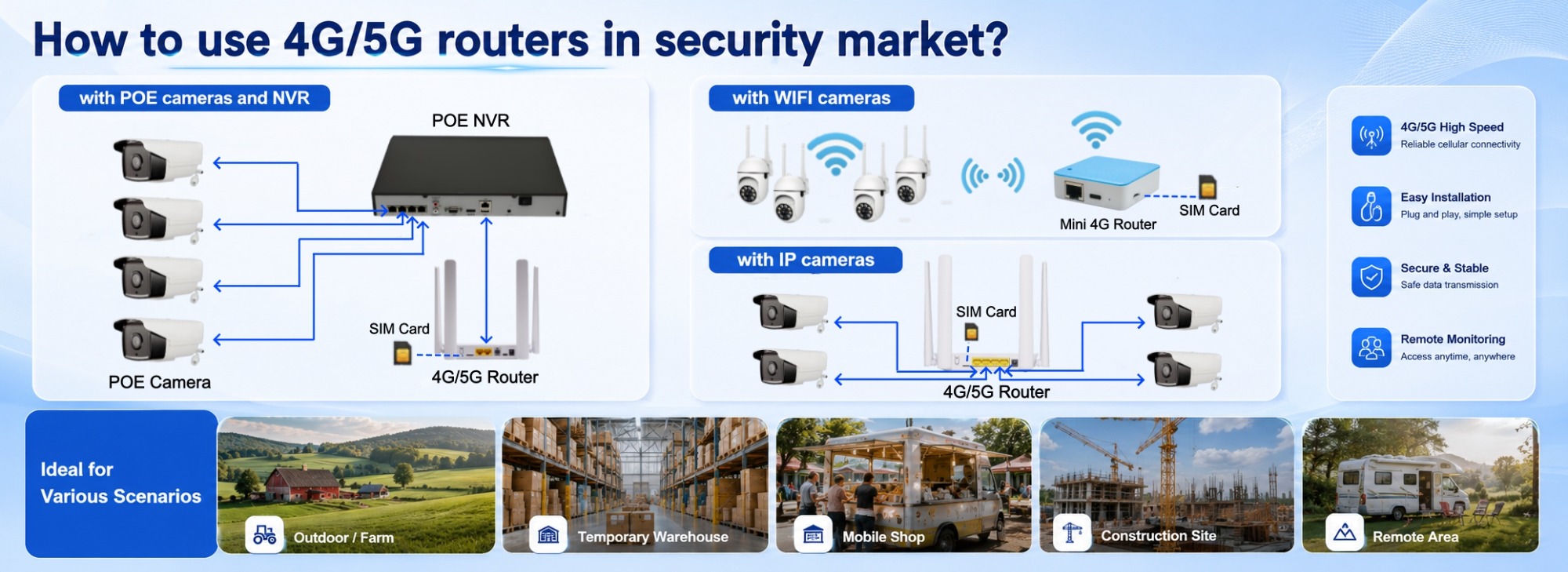
3. 4G LTE vs. 5G Routers: Which Is Better for Security Surveillance?
Both 4G and 5G wireless routers can support IP surveillance systems. The right choice depends on the number of cameras, video resolution, network traffic, cellular coverage, and project budget.
| Feature | 4G LTE Router | 5G Router |
|---|---|---|
| Network speed | Suitable for many standard surveillance applications | Higher potential throughput |
| Video transmission | Suitable for common HD camera setups | Better suited to demanding multi-camera and high-resolution setups |
| Network latency | Generally higher than 5G | Generally lower |
| Deployment cost | Usually more economical | Typically higher |
| Best applications | Small businesses, farms, remote monitoring, basic CCTV | Large surveillance systems, high-bandwidth video, demanding deployments |
When to choose 4G:
For small surveillance systems with a limited number of cameras, 4G LTE routers can provide a cost-effective connectivity solution. They are particularly suitable for remote locations, small businesses, and projects where network bandwidth requirements are moderate.
When to choose 5G:
For projects involving multiple high-resolution cameras, higher video transmission requirements, or large amounts of network traffic, 5G routers offer greater bandwidth potential and lower latency.
However, actual performance depends on cellular coverage, network congestion, router specifications, and the data plans provided by mobile operators.
4. What Should You Consider When Choosing a 4G/5G Router for CCTV?
Not every wireless router is equally suitable for surveillance applications. Before selecting a device, security system integrators and distributors should consider several important factors.
1. Ethernet Port Configuration
Wired IP cameras and NVRs require Ethernet connectivity. Check the number of LAN ports available and whether the router can support the intended network setup.
For larger systems, an external Ethernet switch can be used to connect additional cameras.
2. Wi-Fi Capability
Some surveillance cameras support Wi-Fi connectivity. A router with stable Wi-Fi performance can simplify installation and reduce the need for additional network cabling.
Dual-band Wi-Fi may also help accommodate different connected devices and network requirements.
3. Cellular Network Compatibility
Check supported LTE or 5G bands and ensure that the router is compatible with local mobile operators.
Signal strength and network coverage are particularly important for remote surveillance deployments.
4. Network Stability and Continuous Operation
Surveillance systems may operate 24/7. Therefore, router stability, thermal design, firmware reliability, and long-term operating performance should all be considered.
5. Remote Management and Security
For professional deployments, remote device management, secure network access, firewall capabilities, and VPN support can be valuable features.
These functions help installers and operators manage distributed surveillance networks more efficiently.
5. Why Cellular CPE Routers Are a Flexible Choice for Security Integrators
For security system integrators and distributors, cellular CPE routers offer more than just an alternative internet connection.
They create opportunities to deliver complete connectivity solutions for different surveillance scenarios.
Instead of depending entirely on fixed broadband infrastructure, integrators can select a suitable 4G or 5G CPE based on the installation environment, camera requirements, and local network conditions.
For example:
-
A compact 4G CPE can be used for small-scale surveillance installations.
-
A multi-port 4G router can connect wired cameras and an NVR.
-
A high-performance 5G CPE can support more demanding video transmission requirements.
-
A cellular router can provide backup connectivity for existing broadband-based surveillance systems.
This flexibility makes 4G/5G CPE routers a valuable addition to the product portfolios of security equipment suppliers and smart home solution providers.
Conclusion
As IP cameras and smart surveillance systems continue to expand, flexible and reliable internet connectivity is becoming increasingly important.
4G LTE and 5G wireless routers help overcome the limitations of traditional wired broadband by enabling surveillance systems to operate in remote locations, temporary facilities, and areas where fixed internet access is unavailable.
Whether used as a primary internet connection or a backup network, cellular CPE routers provide a practical way to connect security cameras and monitoring equipment.
For security system manufacturers, distributors, and integrators, incorporating 4G/5G wireless connectivity into surveillance solutions can open up new opportunities in an increasingly connected security market.
Looking for a reliable 4G or 5G CPE router for your security surveillance projects?
SmileMBB provides 4G LTE and 5G CPE router solutions with OEM/ODM customization options, helping partners develop wireless connectivity products for different market requirements and application scenarios.
Contact our team to explore the right connectivity solution for your next project.